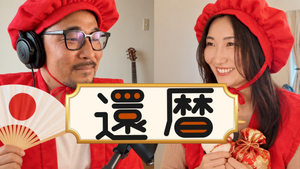
What's kanreki? And why the red vest?
Kanreki (還暦) came up a few times in this episode. It's the celebration of someone's 60th birthday.
Japan has an old way of counting years called jikkan junishi (十干十二支), which combines ten signs with the twelve zodiac animals. There are sixty combinations in total, so the whole cycle takes exactly sixty years to come back around. That means at 60, you return to the same eto (干支, zodiac sign) you were born under.
The calendar has come full circle — koyomi ga kaeru. That's where the word kanreki comes from.
The red chanchanko
The best-known kanreki custom is wearing a red chanchanko (ちゃんちゃんこ), a sleeveless padded vest that children used to wear.
Why red? Two reasons are usually given.
One is that red is believed to ward off bad luck. The other goes back to that idea of coming full circle: if sixty years completes the cycle, then you've returned to being a baby. So you celebrate by wearing something a baby might wear.
Sometimes a red hood (zukin) and a red cushion (zabuton) come with it.
These days, though
Honestly, a lot of people would rather not wear the red vest.
Sixty-year-olds today are still working, still going to the gym, still traveling. Handing someone like that an outfit that says "okay, you're a grandpa now" can land a little awkwardly.
So families often celebrate with a trip or a nice dinner instead. The chanchanko still shows up — but in many cases, only for the photo.
Kanreki is just the first one
Longevity celebrations don't stop at 60:
- Koki (古希) — 70
- Kiju (喜寿) — 77
- Sanju (傘寿) — 80
- Beiju (米寿) — 88
- Sotsuju (卒寿) — 90
- Hakuju (白寿) — 99
Kanreki sits at the very start of that list. Which makes 60 feel less like an ending and more like a starting line.
単語 (Vocabulary)
Join the Penguin Family 🐧
Full transcript+Furigana · Premium video · Vocab & topic lists —
all in Silver Penguin!
